
Vietnam’s digital landscape is shifting - and Gen Z is steering the wheel. Once dominated by visual-first platforms like TikTok and Facebook, the country is now seeing a rise in text-based platforms such as Threads, alongside rapid growth in live commerce, electric ride-hailing, audio streaming and mobile banking.
In this episode of You Don’t Know Vietnam, we unpack the key trends from Decision Lab’s Q4 2024 Connected Consumer Report, revealing how younger users are reshaping what relevance looks like in Vietnam’s fast-evolving digital world.
Download the full Connected Consumer Q4 2024 report here.
Vietnam has never been a stronghold for text-based social media. Twitter (now X) didn’t quite land here the way it did in other markets such as Indonesia. For years, social media in Vietnam has been dominated by visual-first platforms like Facebook, TikTok, and Zalo.
But that’s starting to shift — and it’s happening fast.
Meta’s new text-focused platform, Threads, is gaining traction, and Gen Z is driving the change.
Threads: Gen Z’s Text-First Playground
According to Decision Lab’s latest report, Threads is quietly carving out a niche — especially among Gen Z.
With a current penetration of 15% and younger users making up over a quarter of that base, Threads is emerging as a space for curated, interest-led scrolling.
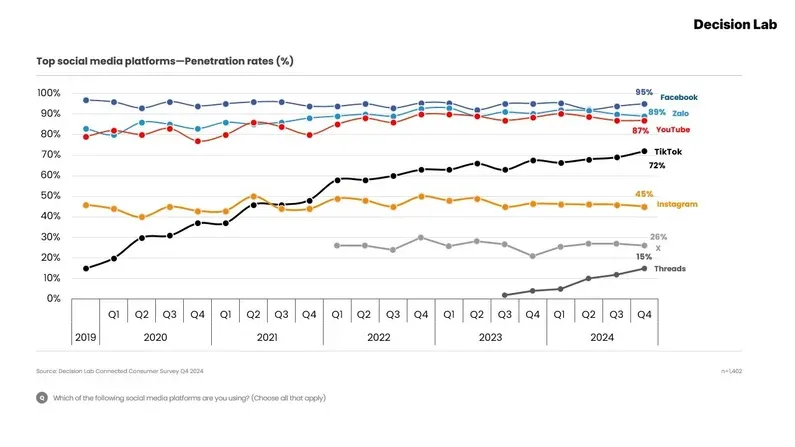
Its rapid rise is down to two things.
First, adoption: users can easily jump straight in from Instagram or Facebook.
Secondly, Meta’s cross-platform algorithm means users are served relevant content from day one. No need to build a new feed from scratch — Threads already knows what you’re into.

Threads is being used to stay up to date on specific interests. For example, one of my colleagues is really into matcha and matcha cafés. Threads picks up on that and starts feeding her posts about hidden matcha spots or niche chains that specialise in it.
Thuy Tien
Decision Lab
It’s still early days, but for brands, that’s exactly the opportunity.
“It’s (Threads) not as commercialised yet,” Thue says. “Which makes it a great space to experiment.”
Shopping meets streaming: The maturation of live commerce
While Threads is still building its user base, live commerce has already arrived.
It’s no longer a fringe or experimental activity — it’s now one of the most important ways Vietnamese consumers shop online.
TikTok helped popularise the format, but recent updates from Facebook — including in-stream product tagging and integrated chat — have made it a serious player again.
Tien notes that major brands like L’Oréal are not only participating but really scaling their efforts. In fact, much of the global brand’s live commerce playbook started right here in Vietnam, says Thue.
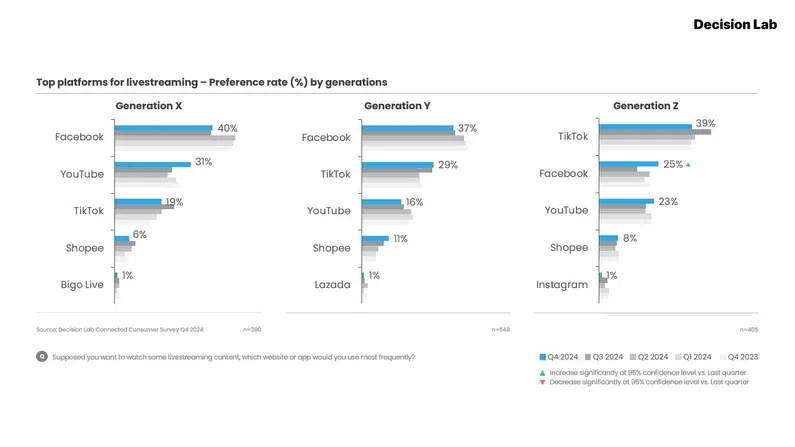
What’s driving this evolution?
A mix of platform innovation and fan-powered trust.
Influencers and KOLs bring real-time interaction to the experience, and that makes live shopping feel more personal — even more entertaining.
And unlike traditional e-commerce, it brings back the human touch.
Rides, reimagined: how Xanh SM is changing the game
If live commerce is redefining how people shop, Xanh SM is quietly changing how they move.
The electric ride-hailing service from Vingroup has seen rapid adoption, reaching 50% usage and narrowing the gap with Grab – according to Decision Lab’s Connected Consumer report from Q4 2024.
But this isn’t just a price war.
Xanh SM is winning over younger users with a mix of purpose and polish.
The angle speaks to sustainability-conscious Gen Z consumers.
But it’s also about experience — cleaner cars, better service, and thoughtful features like showing CO₂ savings per ride.
Gen Z seems to be drawn to the value-added experience... price is no longer the main driver behind Gen Z’s brand choices.
Thuy Tien
Decision Lab
It’s a shift that challenges long-held assumptions about Vietnam being a price-first market. Gen Z is proving otherwise.
Sound on: the audio opportunity in Vietnam
From movement to media — the way Vietnamese consumers listen is also evolving.
YouTube is the clear winner in the audio space, with 75% of respondents using it for music and podcast streaming.
It’s followed by Spotify, while Apple Music remains far behind, largely due to its subscription-only model and the country’s Android dominance.
But beneath those numbers is a bigger story for brands: audio is becoming a valuable — and underused — touchpoint.

There’s so much focus on video, but audio is more intimate. It fits into daily routines — at the gym, during commutes, late at night while putting kids to bed.
Thue Quist Thomasen
Decision Lab
As consumption grows, so will creative opportunities — especially for brands ready to think beyond video, which is where most of the advertising dollars are traditionally spent.
Money moves: the blurring line between banks and eWallets
Finally, no discussion about Vietnam’s digital landscape would be complete without looking at how people are paying.
While MoMo still leads the eWallet space, its growth has levelled off, according to Decision Lab's Connected Consumer Report.
Meanwhile, banking apps are gaining momentum, driven by the widespread use of QR codes and more polished mobile experiences.
The old assumption that banks are clunky and slow no longer holds up in Vietnam.
Traditional Vietnamese banks are rolling out new features fast — and they’re doing it with one goal: reclaim relevance among younger users.
At the same time, eWallets are expanding horizontally, offering everything from budgeting tools to insurance.
“Gen Z may never walk into a bank branch,” Thue says. “But they’re already managing money through apps — and whoever serves them best will win.”

What this all means
Vietnam is moving fast — and not just in terms of adoption.
It’s also evolving in how consumers think.
Whether it’s a social app, a ride-hailing platform, or a payment system, the message is the same:
Relevance is earned — and the window to earn it opens early.