Let’s begin with a short story.
In a noodle shop in Ho Chi Minh City, a woman forgets her wallet.
The owner waves her off: “Come back and pay later.”
Now pause. Imagine trying that in London.
Vietnam runs on trust. Not blind trust, it’s social trust. Personal connections. Gut feel.
Meanwhile, blockchain strides in like a tech bro with something to prove, declaring: “Good news! I’ve invented a way for you to never have to trust anyone again!”
And somewhere in the corner, Vietnam blinks slowly and replies: “But... we already do.”
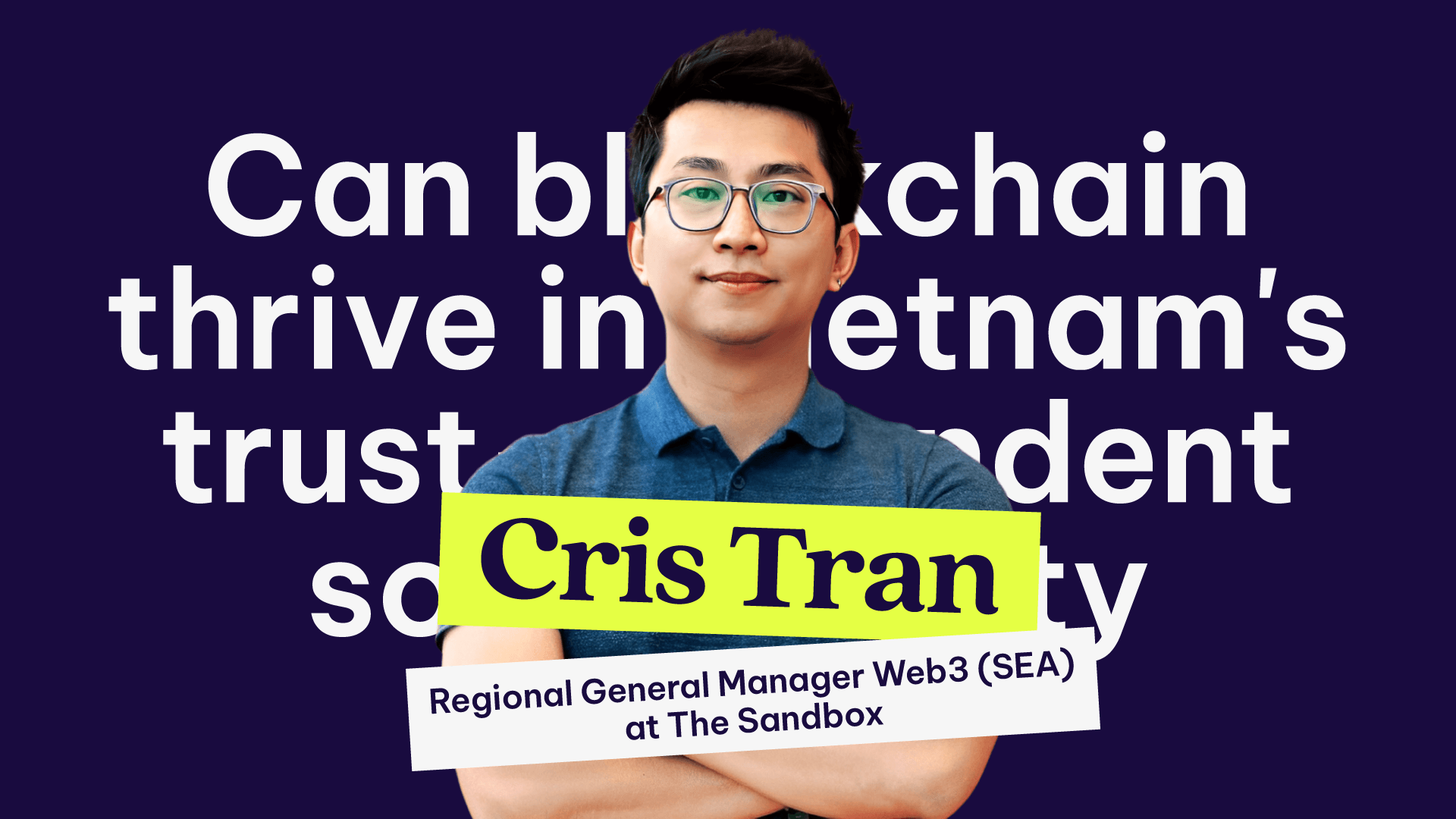
In this episode of You Don’t Know Vietnam, we sit down with Cris D. Tran, Regional General Manager of Web3 (SEA) and Head of Growth (VN) at The Sandbox, to unpack what happens when the most trust-saturated culture in Southeast Asia meets the most trustless technology ever invented.
We talk about scams, startups, gaming, blockchain, Gen Z, and governance.
And underneath it all, one question: Can Vietnam, a country powered by social trust, thrive in a system built to eliminate it?
This is where our story begins.
Key takeaways:
Trust is Vietnam’s operating system
Vietnam needs blockchain
Gen Z is already on board
Trust is evolving
Trust issues: Vietnam loves blockchain… but not for the reason you think
Vietnam consistently ranks among the top countries in crypto adoption. One stat even claims 16% of the population hold some form of cryptocurrency.

I think the real number is even higher. But I don’t think most of them really understand what blockchain is. They just see the price go up and think: "I'm in."
Cris D. Tran
Regional General Manager - Web3 (SEA)
Which means that?
It’s not decentralisation or transparency that’s drawing the masses in. It’s FOMO. (Fear Of Missing Out)
In other words, we’re trusting the wrong people in a trustless world. Telegram influencers. Crypto Tiktokers. Old schoolmates with new Lambos. Meanwhile, the very technology built to protect us from fraud becomes the medium of it.
“They tend to sugarcoat like the project with Web3 component”, says Cris, “but the people behind it are still just running scams the old-fashioned way”
They tend to sugarcoat like the project with Web3 component, but the people behind it are still just running scams the old-fashioned way
Cris D. Tran
Regional General Manager - Web3 (SEA)
The irony of trustless tech in a culture addicted to personal promises
In Vietnam, no business is really official until there’s a handshake, a drink, and preferably, a mutual cousin.
Paperwork is performative. What matters is the relationships.
Which is exactly what blockchain removes. It replaces sentiment with signature. Human warmth with hash functions.
So it jars, culturally. Trustless contrasts? But we like trusting people. We like chatting before signing. We like checking if you’re “chỗ quen biết” (have insider connections).
Why, actually, Vietnam might need blockchain more than anyone
Yes, Vietnam is all about trust. But also:
- ID fraud is rampant
- Document verification is a bureaucratic nightmare
- Supply chains leak value like a burst pipe
In short, it’s a perfect candidate for blockchain.
Imagine going to a government office, and instead of chasing five signatures across three districts, your document is verified instantly with a QR scan.
Cris D. Tran
Regional General Manager - Web3 (SEA)
Why? Because the truth is no longer locked in a drawer or waiting on someone’s lunch break. It’s on-chain: timestamped, tamper-proof, and sitting in public view like a dog with nothing to hide. The QR code isn’t magic. It’s just a front door to proof that can’t be faked or ‘accidentally misplaced’.
Blockchain in Vietnam wouldn’t be a luxury. It’d be a patch for systemic inefficiency.
It could turn chaos into coordination.
“It doesn’t make the chaos go away. It makes chaos more comfortable for everyone.” Cris laughs.
Can trustless tech have a beating heart?
This is where it gets interesting.
The new generation of Vietnamese, the Gen Zs and Alphas, weren’t raised on handshakes and face-saving.
They were raised on apps, screens, and anonymous usernames.
They don’t want to talk to your uncle. They want fast UX and instant payouts.
“45% of our users globally are aged 18-28”, says Cris, talking about The Sandbox’s metaverse platform.
“And in Vietnam alone, our player base went from 30,000 to 300,000 in under a year.”
And in Vietnam alone, our player base went from 30,000 to 300,000 in under a year.
Cris D. Tran
Regional General Manager - Web3 (SEA)
This is not a generation that asks for permission.
They’re building in Web3, playing in it, investing in it. And they’re not asking who your dad knows before signing a deal.
For them, trustlessness is the default. Not a bug. Not a feature. Just…obvious.
Culture evolves. So will trust.
Blockchain won’t bulldoze Vietnamese culture. It’ll stretch it.
It’ll force the next generation of startups to trust differently:
- Trust in logic, not lineage
- Trust in code, not character
- Trust in systems, not sentiment
And let’s be honest, that evolution is overdue.
Because no matter how warm and fuzzy personal trust feels, it’s not scalable.
Blockchain isn’t here to kill trust. It’s here to curate it.
In the end, “trustless” doesn’t mean “no trust”.
It means trust is earned, not assumed. Measured, not promised. Transparent, not whispered over a beer.
And maybe that’s exactly what Vietnam, a country on the cusp of technological transformation, needs right now.
Because when trust is everywhere, so is the risk of it being misplaced.
And blockchain?
It doesn’t demand your trust. It just proves whether it’s deserved.